See your life
in weeks.
Enter your birthday. Each dot is one week of an 80-year life — fifty-two across, eighty down. The orange ones are gone; the one still burning is this week.
Stays on this page. Nothing is sent anywhere.
What is a life calendar?
A life calendar — a life in weeks grid — is a chart with one box for every week of a life: fifty-two across, one row per year, so a whole lifetime fits on a single page. You fill in the weeks behind you and see, at a glance, what remains.
Tim Urban’s essay “Your Life in Weeks” and Oliver Burkeman’s Four Thousand Weeks made the format famous; the practice underneath it is centuries older. The grid above is One Last Second’s version — a calmer way to see your time than any countdown.
How many weeks
are in a life?
About four thousand. An 80-year life is 4,160 weeks — 52 for every year, the number this page draws. Tim Urban’s original chart runs to 90 years, which is 4,680 weeks; Oliver Burkeman takes the 80-year figure and rounds it down to the four thousand of his title. Different horizons, same point.
However you draw it, the number is smaller than it feels like it should be — small enough to fit on one screen, with every week you’ll ever have visible at once.
give or take — the three spans are the whole grid
Your life in weeks, by age
Every year of life is 52 dots. At forty, the 80-year grid is exactly half full — 2,080 weeks gone, 2,080 to go.
| Age | Weeks lived | Weeks left |
|---|---|---|
| 18 | 936 | 3,224 |
| 25 | 1,300 | 2,860 |
| 30 | 1,560 | 2,600 |
| 40 | 2,080 | 2,080 |
| 50 | 2,600 | 1,560 |
| 60 | 3,120 | 1,040 |
| 70 | 3,640 | 520 |
| 80 | 4,160 | 0 |
whole 52-week years — the calculator above counts yours to the day
Weeks, months, or days?
Eighty years is 4,160 weeks, 960 months, or about 29,220 days. Weeks are the honest middle: days are too many to hold in mind, months too few to feel. A week is the unit a life is actually lived in — small enough to count, big enough to mean something when one goes.
one dot each, above
twelve per row of years
leap days included
The tail end
Most of the time you’ll spend with the people you love has a countable shape. Tim Urban’s companion essay “The Tail End” runs the arithmetic: by the time you leave home at eighteen, you may have spent around 93% of the in-person time you’ll ever have with your parents. The rest is a number — and numbers can be changed.
Summers left at forty
In-person parent time spent by eighteen
Weekends left at forty
the remainder isn’t a warning — it’s a reason to schedule the visit
Memento mori
Memento mori is Latin for remember, you will die — the Stoic practice of keeping your finitude in view. Not as a warning. As a way of seeing: when time is finite, the ordinary becomes sacred.
A year feels endless; fifty-two dots don’t. Seen this way, an ordinary Tuesday stops being something to get through and starts being one of the dots you actually get. This grid is that practice made visible — and One Last Second is built around it.
Read the manifesto→Keep the grid.
Fill it in.
This grid is the Life screen of One Last Second — a 3-second daily video journal. Film one three-second moment a day, and the weeks stop being empty dots: each one holds real footage of the life you were living.
A countdown to midnight, and whether you showed up today.
Every month stitches itself into a small film of your moments.
Old days resurface a month, six months, a year later.
No feed, no strangers. Your moments stay yours.

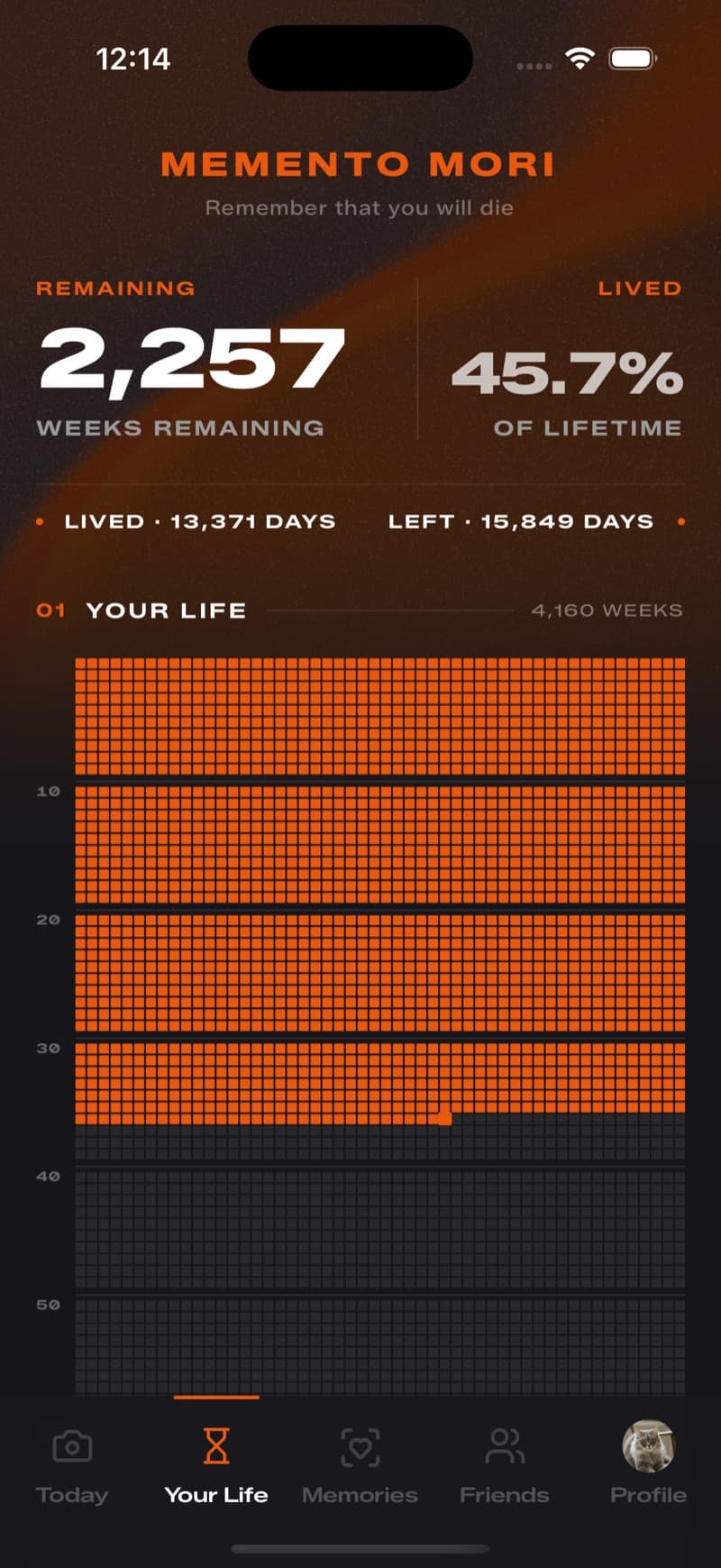
The same grid, always one tap away.
How does the life in weeks calculator work?
Enter the day you were born and the grid fills in — one dot for every week you’ve been alive, out of the 4,160 weeks in an 80-year life. Everything is computed by your browser on your own device. Your birthday never leaves the page; it’s saved only in your browser so the grid is still filled in next time.
How many weeks are in 80 years?
4,160 weeks — 52 weeks for each of 80 years, which is how the grid counts. By the calendar it’s slightly more, about 4,174 weeks, once leap days are included. This page uses the 52-per-row figure so every year is one clean row of dots.
How many weeks long is a life?
About four thousand. An 80-year life is 4,160 weeks — the number this grid draws. Tim Urban’s original chart uses 90 years (4,680 weeks), and Oliver Burkeman rounds 80 years down to the four thousand of his book title. Whichever you pick, it fits on one screen.
How many weeks has the average person lived?
Around 1,600 — the average person alive today is roughly thirty years old. A completed life at the world-average expectancy of about 73 years comes to roughly 3,800 weeks. At forty you’ve lived about 2,080, exactly half the 80-year grid. The calculator above counts yours to the day.
How many weeks are in a year?
Fifty-two, plus one day — 365 days is 52 weeks and one day over; leap years leave two. Those loose days are why the grid draws 52 dots per year and lets the calendar drift a little.
What is a life in weeks calendar?
A grid with one box for every week of a life — 52 across, one row per year. You mark how many are behind you and see, at a glance, what remains. Tim Urban’s essay “Your Life in Weeks” and Oliver Burkeman’s book Four Thousand Weeks made the format famous; the idea underneath it is far older.
Why 80 years?
It’s the horizon One Last Second draws in the app — a round eighty years, close to a full life expectancy. The grid is a horizon, not a prediction: some people get more rows, some fewer. The point isn’t precision; it’s that the number of dots is finite, and visibly so.
How many summers do I have left?
Subtract your age from eighty. At forty, that’s about forty more summers. Counting what remains in events instead of weeks — summers, visits, weekends — is the idea behind the tail end, and it tends to land harder than any number of dots.
See the tail end →Is this a death clock?
No. A death clock guesses a date for you and counts down to it for shock value. This calculator predicts nothing — the 80-year horizon is fixed and honest about being an estimate, and the point is to see the weeks you have, not to fear a date. A calmer way to look at time.
How is this different from a life expectancy calculator?
A life expectancy calculator estimates how long you might live from actuarial tables — age, sex, country, habits — usually for retirement or insurance planning. This page estimates nothing about you: it fixes one horizon, 80 years, and shows your time against it. A different question — not “how long?” but “what does it look like?”
What is memento mori?
Latin for “remember, you will die.” The Stoics kept the thought close — not as morbidity, but as a way of seeing: when time is finite, the ordinary becomes sacred. This grid is that practice made visible, one week at a time.
Read the manifesto →Can I keep my grid?
Yes — it lives in One Last Second, an iPhone app built around this exact grid. Film one 3-second video a day and the weeks stop being empty dots: each one holds real footage of the life you were living. The app is on the App Store.
Get the app →iOS, out now. Three seconds before midnight — that’s the whole ask.

Three seconds a day — on the App Store